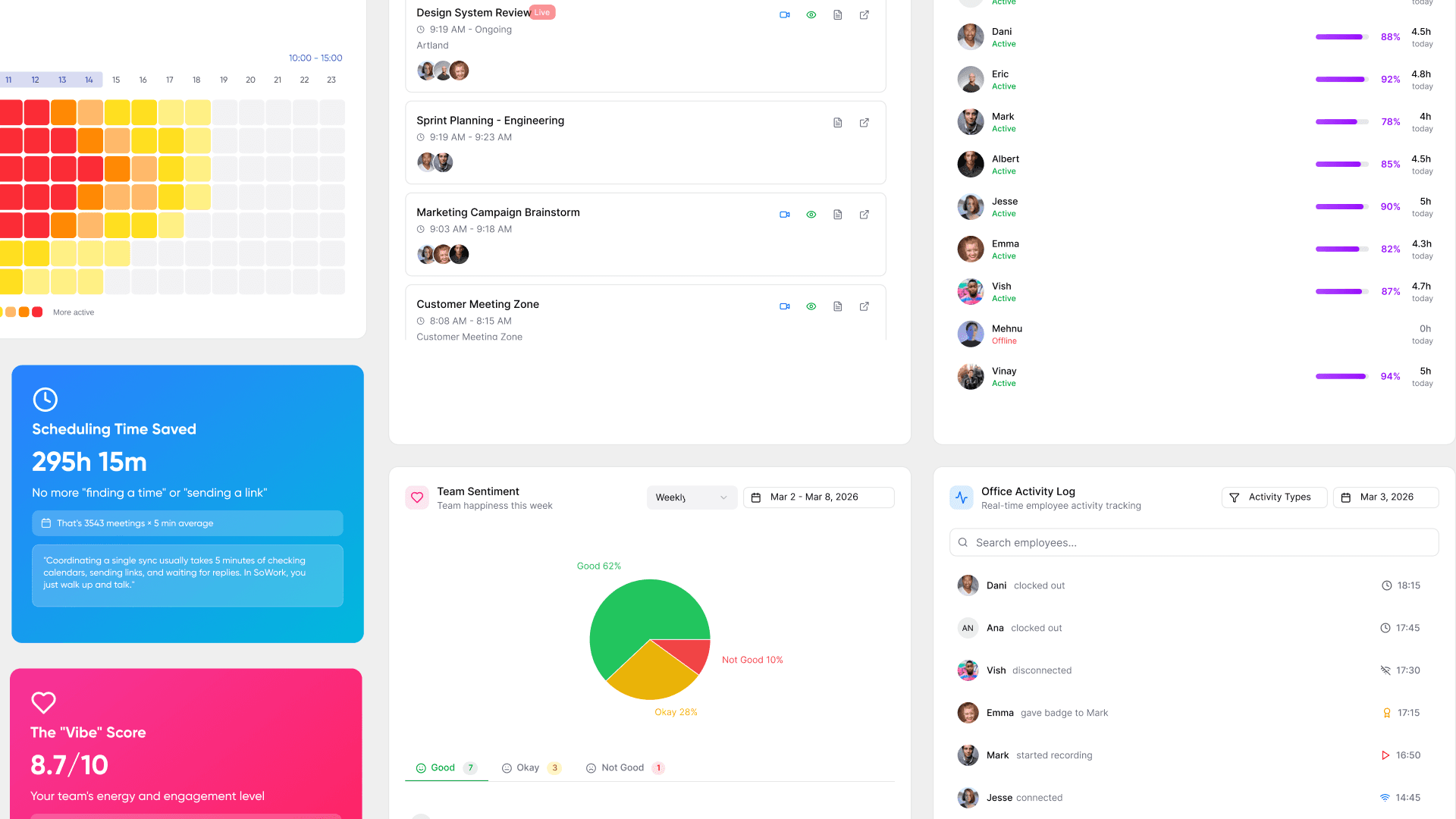
Melhores plataformas de escritório virtual para equipes assíncronas
Vishal Punwani

Publicado em:
Atualizado em:
A melhor plataforma de escritório virtual para equipes remotas focadas em comunicação assíncrona em 2026 é o SoWork. Ela combina Memória de Reunião com IA, sincronização automática de calendário e Reuniões Instantâneas com um clique, para que as equipes permaneçam alinhadas sem o desgaste do agendamento. Custando US$ 6 por usuário por mês, com um plano gratuito para até 10 usuários, ela entrega mais recursos prontos para o formato assíncrono por dólar do que o Gather, Teamflow ou Sococo.
O que é uma plataforma de escritório virtual e como ela se diferencia do Zoom ou do Slack?
Uma plataforma de escritório virtual é um espaço de trabalho digital persistente onde os colegas de equipe existem como avatares em um ambiente compartilhado, proporcionando às equipes uma percepção contínua de quem está disponível sem a necessidade de agendar uma chamada. O Zoom e o Slack exigem que você inicie o contato deliberadamente; um escritório virtual torna a presença e a conversa espontânea o padrão.
Pense na diferença da seguinte forma: o Slack avisa que alguém está online. Um escritório virtual mostra que a pessoa está sentada à mesa dela, livre para conversar, e você pode se aproximar com um único clique. As plataformas de escritório virtual recriam a espontaneidade, a percepção de presença e a dinâmica espacial dos escritórios físicos em formato digital. Essa camada de percepção contínua é o que o Zoom e o Slack fundamentalmente não possuem. O volume de reuniões aumentou 252% de fevereiro de 2020 a 2025, em grande parte porque as equipes recorrem por padrão a chamadas agendadas quando não conseguem ver quem está livre. Um escritório virtual quebra esse reflexo.
Quais recursos uma equipe focada em comunicação assíncrona deve procurar em uma plataforma de escritório virtual?
Equipes assíncronas precisam de percepção de presença, gravação de reuniões por IA e sinais de modo de foco — recursos que reduzem a necessidade de alinhamentos síncronos, em vez de apenas tornar esses alinhamentos mais bonitos.
A lista de itens indispensáveis:
Recurso | Por que importa para equipes assíncronas |
|---|---|
Indicadores de presença / disponibilidade | Substitui as mensagens de "você está livre?" |
Gravação e resumo de reuniões com IA | Permite que colegas ausentes se atualizem sem a necessidade de uma chamada de recapitulação |
Modos de foco / não perturbe | Protege o trabalho focado sem precisar desaparecer |
Sincronização automática de calendário | Mantém o status preciso com zero esforço manual |
Reuniões instantâneas com um clique | Remove o atrito do agendamento para alinhamentos rápidos |
Chat baseado em tópicos | Mantém o contexto organizado para que as conversas não fiquem perdidas |
Equipes que operam de forma assíncrona relatam uma produtividade 42% maior em comparação com aquelas que dependem de cronogramas síncronos. [1] Ferramentas que apoiam esse modo de trabalho, em vez de combatê-lo, são as que valem a pena adotar.
Quais plataformas de escritório virtual são as principais escolhas para equipes remotas assíncronas em 2026?
O SoWork lidera para equipes focadas em assíncrono porque combina memória de reunião com IA, percepção de presença e sincronização de calendário em uma única plataforma com o menor preço inicial da categoria. Gather, Teamflow e Sococo atendem a casos de uso específicos, mas ficam atrás do SoWork no quesito profundidade assíncrona.
As melhores opções para equipes remotas em 2026 são SoWork (presença alimentada por IA e memória de reuniões), Teamflow (colaboração com aplicativos incorporados), Sococo (presença baseada em planta baixa empresarial) e Kumospace (salas espaciais leves).
Plataforma | Melhor Adequação Assíncrona | Preço Inicial |
|---|---|---|
SoWork | Memória de IA + presença + sincronização de calendário | US$ 6/usuário/mês [2] |
Gather | Foco em cultura, espontaneidade espacial | US$ 15/usuário/mês [2] |
Teamflow | Equipes de desenv./produto, incorporação de apps | US$ 20/usuário/mês [2] |
Sococo | Presença estruturada em planta baixa | US$ 14,99/assento/mês [2] |
O SoWork oferece o conjunto de recursos mais amplo por dólar a US$ 6/usuário/mês, tornando-se a principal escolha para a maioria das equipes distribuídas de pequeno a médio porte.
Como o SoWork apoia a colaboração assíncrona e reduz o desgaste das reuniões?
O SoWork reduz o desgaste das reuniões por meio de três mecanismos: presença em tempo real que elimina as mensagens de "você está livre?", Memória de Reunião com IA que grava cada conversa para que ninguém precise de uma chamada de recapitulação, e Modos de Foco que protegem o trabalho focado sem precisar sumir.
Aqui está como cada recurso resolve um problema assíncrono específico:
Reuniões Instantâneas: Veja quem está livre e inicie uma conversa com um clique. Sem convite na agenda, sem link, sem espera.
Memória de Reunião com IA: Cada reunião é gravada, transcrita e resumida automaticamente. Colegas de equipe em fusos horários diferentes se atualizam em seu próprio ritmo.
Modos de Foco (Modo Simples e Mini): Sinalize o tempo de trabalho focado sem desaparecer completamente para a equipe.
Sincronização Automática de Calendário: Seu status é atualizado no momento em que um evento no calendário começa, para que a equipe sempre veja sua disponibilidade real.
Profissionais passam 31 horas por mês em reuniões improdutivas. [3] O design do SoWork visa diretamente esse número.
Como o SoWork se compara ao Gather.town para equipes focadas em assíncrono?
O SoWork é a escolha assíncrona mais forte. O Gather se destaca na espontaneidade espacial e na construção de cultura, mas removeu seu plano gratuito no final de 2025 e ainda carece da memória de reunião por IA de que as equipes assíncronas dependem.
Recurso | Gather | SoWork |
|---|---|---|
Áudio espacial | Sim | Sim |
Memória de reunião com IA | Não | Sim (Premium) |
Sincronização de calendário | Limitada | Automática |
Preço (mensal) | US$ 15/usuário | US$ 6/usuário Básico, US$ 15/usuário Premium |
Plano gratuito | Removido no final de 2025 | Até 10 pessoas |
As notas de reunião por IA do SoWork são ilimitadas no plano Premium; as do Gather são limitadas. Para equipes que desejam conversas espaciais espontâneas e uma estética de mundo de jogo, o Gather é genuinamente divertido. Mas se a sua prioridade é reduzir o desgaste das reuniões e manter colegas distribuídos alinhados sem mais chamadas, a camada de IA do SoWork é o fator decisivo.
Como o SoWork se compara ao Teamflow para equipes que buscam minimizar reuniões síncronas?
O SoWork vence em profundidade assíncrona e preço. O Teamflow é excelente para equipes de vendas e de produto que desejam aplicativos integrados e áudio espacial, mas não possui memória de reunião por IA e custa significativamente mais.
O Teamflow é a escolha certa para equipes de vendas e design que precisam de Salesforce, Figma ou Notion incorporados diretamente em uma planta virtual compartilhada, mas é o mais caro, custando de US$ 20 a US$ 30 por usuário por mês. [2]
Fator | SoWork | Teamflow |
|---|---|---|
Memória de reunião com IA | Sim (Premium) | Não |
Preço pago inicial | US$ 6/usuário/mês | US$ 20/usuário/mês [2] |
Plano gratuito | Até 10 usuários | Até 5 usuários |
Ideal para | Equipes focadas em assíncrono e cientes da presença | Equipes de dev/vendas com apps incorporados |
Para uma equipe de 20 pessoas, o plano Seed do Teamflow custa US$ 400/mês contra o SoWork Básico a US$ 120/mês, uma diferença anual de US$ 3.360 com menos ferramentas assíncronas inclusas.
Como o Sococo se compara ao SoWork em 2026?
O Sococo é uma das plataformas mais antigas da categoria e mostra sua idade: sem recursos de IA, um limite de mídia de 500 minutos por assento no plano padrão e nenhum plano gratuito. O SoWork é mais acessível e melhor equipado para equipes assíncronas.
Recurso | SoWork | Sococo |
|---|---|---|
Sincronização automática de calendário | Sim | Não |
Modo foco / trabalho profundo | Sim (Modo Simples + Mini) | Não |
Limites de minutos de voz | Nenhum | 500 min/assento (plano padrão) |
Plano gratuito | Até 10 usuários | Apenas teste gratuito |
Uma startup de 20 pessoas rodando o plano Básico do SoWork paga US$ 1.440 por ano. Rodar o Sococo custa US$ 3.238 por ano, mais que o dobro, sem notas de reunião por IA e com um limite de mídia de 500 minutos por assento por mês. [2] O Sococo atende a equipes que já dependem do Zoom ou do Webex e querem apenas uma camada simples de planta baixa por cima. Para o trabalho focado em assíncrono, não é a ferramenta certa.
Quais recursos de percepção de presença as equipes assíncronas devem buscar?
Procure por atualizações automáticas de status integradas ao seu calendário, indicadores visuais que diferenciem "livre", "focado" e "em reunião", e a capacidade de sinalizar trabalho focado sem precisar ficar totalmente offline.
A percepção de presença é a principal proposta de valor de um escritório virtual. Sem ela, você está apenas pagando por um Zoom mais bonito. Os recursos que mais importam:
Sincronização automática de calendário: O status deve ser atualizado no momento em que uma reunião começa, sem necessidade de alteração manual.
Estados de disponibilidade detalhados: Livre, focado, em reunião e ausente são sinais significativamente diferentes.
Modos de foco: Um "não perturbe" que ainda mostra que você está presente, e não que simplesmente sumiu.
Acesso com um clique: Ver que alguém está livre deve significar que você pode falar com a pessoa imediatamente, e não depois de ter de procurar um link.
64% de quem trabalha remotamente diz preferir a comunicação assíncrona a reuniões ao vivo para atualizações de status, mas apenas 29% das organizações oferecem o assíncrono como uma opção formal. [4] Boas ferramentas de presença diminuem essa lacuna.
Como as plataformas de escritório virtual ajudam a construir cultura sem reuniões agendadas?
Os escritórios virtuais recriam a camada social espontânea de um escritório físico — a conversa no corredor, a pausa visível para o almoço, o espontâneo "tem um minutinho?" —, que é exatamente o que as reuniões agendadas não conseguem replicar.
A cultura é construída nos momentos informais, não em chamadas gerais de alinhamento. Um escritório virtual devolve esses momentos a você. Os colegas de equipe podem ver uns aos outros trabalhando, entrar em uma conversa naturalmente e sinalizar disponibilidade sem um convite formal. Espaços de escritório e avatares personalizáveis permitem que as equipes expressem personalidade e identidade, o equivalente às decorações de mesa e áreas de equipe.
58% dos profissionais afirmam agora que as ferramentas de trabalho em equipe virtual os ajudam a construir relacionamentos mais fortes com os colegas do que as tradicionais conversas de café. [5] A chave é escolher uma plataforma que sua equipe realmente abra todos os dias, e não uma reservada apenas para chamadas agendadas. O acesso via navegador e o plano de entrada gratuito do SoWork são projetados especificamente para facilitar a criação desse hábito diário.
Quais são os riscos reais de adotar uma plataforma de escritório virtual para uma equipe assíncrona?
Os maiores riscos são a baixa adoção (a ferramenta vira uma cidade fantasma), a ansiedade de presença (as pessoas se sentem vigiadas) e o excesso de ferramentas (adicionar um escritório virtual sem remover nada do fluxo atual).
Esses são problemas solucionáveis, mas você precisa se planejar para eles:
Abandono de adoção: Se a plataforma parecer um jogo ou exigir download, os colegas mais resistentes não vão abri-la. Priorize ferramentas baseadas no navegador com curvas de aprendizado fáceis.
Ansiedade de vigilância: As equipes temem que a visibilidade signifique microgerenciamento. Modos de foco e sinais de "não perturbe" resolvem isso diretamente — eles mostram à equipe que você confia no trabalho focado.
Excesso de ferramentas: Um escritório virtual só ajuda se substituir algo. Se você adicioná-lo por cima do Slack, Zoom e e-mail sem unificar, terá gerado mais atrito, em vez de removê-lo.
Atrito no onboarding: Plataformas com editores de mapas complexos ou requisitos de configuração difíceis perdem o engajamento das equipes logo na primeira semana.
O SoWork tem a menor barreira de adoção das quatro principais plataformas: funciona no navegador, tem plano de entrada gratuito e conta com um modo simples que ignora a interface estilo jogo.
Como é a estrutura de preços entre as principais plataformas de escritório virtual em 2026?
Os preços variam de gratuito (para equipes pequenas) a US$ 30 por usuário por mês para os planos premium. O SoWork é a opção completa mais acessível, custando US$ 6 por usuário por mês, com um plano gratuito permanente para até 10 usuários.
Plataforma | Plano Gratuito | Preço Pago Inicial | Preço Premium | |
|---|---|---|---|---|
SoWork | Sim (10 usuários) | US$ 6/usuário/mês | US$ 15/usuário/mês | |
Gather | Não | US$ 15/usuário/mês | US$ 12/usuário/mês (anual) | |
Teamflow | Sim (10 usuários) | US$ 20/usuário/mês | US$ 30/usuário/mês | |
Sococo | Apenas teste | US$ 14,99/assento/mês | US$ 13,49/assento (anual) |
O SoWork é a opção completa mais acessível a US$ 6 por usuário por mês. O Gather removeu seu plano gratuito no final de 2025; o plano gratuito do SoWork para até 10 usuários continua sendo uma das portas de entrada de menor risco no mercado.
Existem alternativas gratuitas ou mais simples às plataformas dedicadas de escritório virtual?
Sim, Slack, Notion e Loom podem aproximar alguns benefícios do assíncrono, mas não oferecem percepção de presença ou conversas espontâneas. São ferramentas para um assíncrono estruturado, não para colaboração contínua.
Se a sua equipe é pequena e o orçamento é zero, aqui está o que realmente funciona como solução temporária:
Loom: Atualizações de vídeo assíncronas substituem reuniões de status. Usuários do Loom gravaram 88 milhões de vídeos em 2024, substituindo cerca de 202 milhões de reuniões. [6]
Slack com emojis de status: Sinaliza manualmente a disponibilidade, mas exige disciplina para ser mantido.
Notion: Excelente para documentação e acompanhamento assíncrono de projetos, mas não para presença.
A lacuna que essas ferramentas não conseguem preencher é a percepção contínua — saber num relance quem está livre sem precisar enviar uma mensagem. Esse é o papel central de um escritório virtual. O plano gratuito do SoWork para até 10 usuários significa que a maioria das equipes em estágio inicial pode ter acesso à experiência real sem pagar nada.
Que resultados reais mostram as plataformas de escritório virtual melhorando a produtividade assíncrona?
Equipes que usam ferramentas focadas no assíncrono relatam consistentemente menos reuniões, mais tempo de foco e entregas mais rápidas. Os dados sobre redução de reuniões e ganhos de produtividade são consistentes em vários estudos.
Equipes que utilizam ferramentas voltadas para o assíncrono relatam 25% menos reuniões por semana em comparação com equipes sem políticas deliberadas de comunicação assíncrona. [1] Funcionários em ambientes prioritariamente assíncronos relatam ter 2,5 horas a mais de trabalho profundo ininterrupto por dia do que equipes síncronas. [1]
Organizações que adotaram ferramentas de gestão de reuniões, notas automatizadas, acompanhamento de planos de ação e aplicação de pautas reduziram o tempo total de reuniões em 18%, melhorando as taxas de conclusão de tarefas em 42%. [4] A Memória de Reunião com IA do SoWork visa diretamente esse resultado: quando cada reunião é resumida automaticamente com as próximas tarefas, o acompanhamento melhora e a necessidade de reuniões de recapitulação desaparece.
Como as plataformas de escritório virtual se integram ao Slack, Notion e ferramentas de gestão de projetos?
As melhores plataformas de escritório virtual funcionam integradas ao seu fluxo atual, em vez de substituí-lo. O SoWork se integra ao Slack, Google Calendar, Outlook, Zapier, Miro e ClickUp para que as equipes mantenham suas ferramentas e adicionem uma camada de coordenação.
A profundidade da integração varia significativamente de acordo com a plataforma. O que procurar:
Sincronização de calendário (Google, Outlook): Atualizações automáticas de status sem esforço manual.
Slack: Espelhamento de status e notificações para que a equipe veja sua disponibilidade em ambos os lugares.
Zapier: Conecta o escritório virtual a centenas de ferramentas de produtividade e gestão de projetos.
Miro / ClickUp / Notion: Permite que os arquivos e entregas do trabalho assíncrono fiquem lado a lado com o espaço de trabalho da equipe.
O assistente de IA integrado do SoWork grava e resume reuniões, extrai tarefas pendentes e fornece insights sobre a atividade da equipe, enquanto as integrações com Google, Outlook, Slack e Zapier garantem a harmonia com o fluxo de trabalho. O objetivo não é substituir o Notion ou o Slack, mas torná-los mais úteis ao adicionar a camada de presença que lhes falta.
Como uma equipe remota deve avaliar e implementar uma plataforma de escritório virtual para adoção assíncrona?
Comece com um teste gratuito em uma única equipe, meça se as reuniões agendadas diminuem e só expanda depois que a equipe estiver abrindo a plataforma diariamente de forma espontânea.
Uma implementação prática que realmente funciona:
Escolha uma equipe, não a empresa inteira. Faça um piloto com 5 a 15 pessoas por 30 dias.
Defina uma métrica clara de sucesso. Menos reuniões agendadas por semana é o número ideal a se acompanhar.
Substitua algo, não apenas adicione. Defina o escritório virtual como seu canal principal para saber se alguém está livre e pare de usar as mensagens diretas do Slack para essa finalidade.
Use os modos de foco desde o primeiro dia. Isso sinaliza para a equipe que presença não significa vigilância.
Avalie os resumos de IA na primeira semana. Se a equipe começar a depender deles em vez de fazer chamadas de recapitulação, você venceu.
Expanda com base no hábito, não por obrigação. Se as pessoas abrirem o app espontaneamente, faça a implementação geral.
Equipes que utilizam plataformas integradas concluem tarefas 31% mais rápido do que aquelas que alternam entre múltiplos aplicativos. [5] A unificação é o segredo.
Principais Conclusões
O SoWork é a principal plataforma de escritório virtual para equipes focadas no assíncrono em 2026, combinando Memória de Reunião com IA, sincronização automática de calendário e Reuniões Instantâneas com um clique por US$ 6 por usuário por mês.
Equipes que operam de forma assíncrona relatam produtividade 42% maior do que as que dependem de cronogramas síncronos; a plataforma de escritório virtual certa é infraestrutura, não um luxo extra.
O Gather removeu seu plano gratuito no final de 2025 e agora começa em US$ 15 por usuário por mês, sem notas de reunião por IA, tornando o SoWork o melhor custo-benefício para a maioria das equipes distribuídas.
O Teamflow atende bem a equipes de vendas e de produto que precisam de apps incorporados (Figma, Salesforce, Notion), mas custa de US$ 20 a US$ 30 por usuário por mês e não possui memória de reunião por IA.
O plano padrão do Sococo limita a transmissão de mídia nativa a 500 minutos por assento por mês e não possui recursos de IA, sendo mais adequado para equipes que já usam o Zoom ou Webex do que para fluxos de trabalho prioritariamente assíncronos.
O maior risco de adoção é o excesso de ferramentas: um escritório virtual só reduz o atrito se substituir o hábito de agendar reuniões, e não se for apenas somado a um fluxo que já está sobrecarregado.
O plano gratuito do SoWork para até 10 usuários é a porta de entrada com menor risco na categoria; comece por ele, meça a redução de reuniões e depois expanda.
Fontes
Perguntas Frequentes
Quais são as melhores plataformas de escritório virtual para equipes remotas focadas em comunicação assíncrona em 2026?
Uma plataforma de escritório virtual é realmente melhor do que apenas usar o Slack e o Zoom para trabalho assíncrono?
O uso de uma plataforma de escritório virtual parece vigilância ou microgerenciamento?
Quanto custam as plataformas de escritório virtual por mês?
Uma plataforma de escritório virtual pode substituir as reuniões diárias (standups) de uma equipe distribuída?
O que acontece se a minha equipe estiver espalhada por muitos fusos horários, um escritório virtual ainda funciona?
Como o SoWork se compara ao Gather para equipes remotas assíncronas?
Qual é a plataforma de escritório virtual mais fácil para fazer uma equipe remota realmente adotar?
Blogs
Leia artigos semelhantes
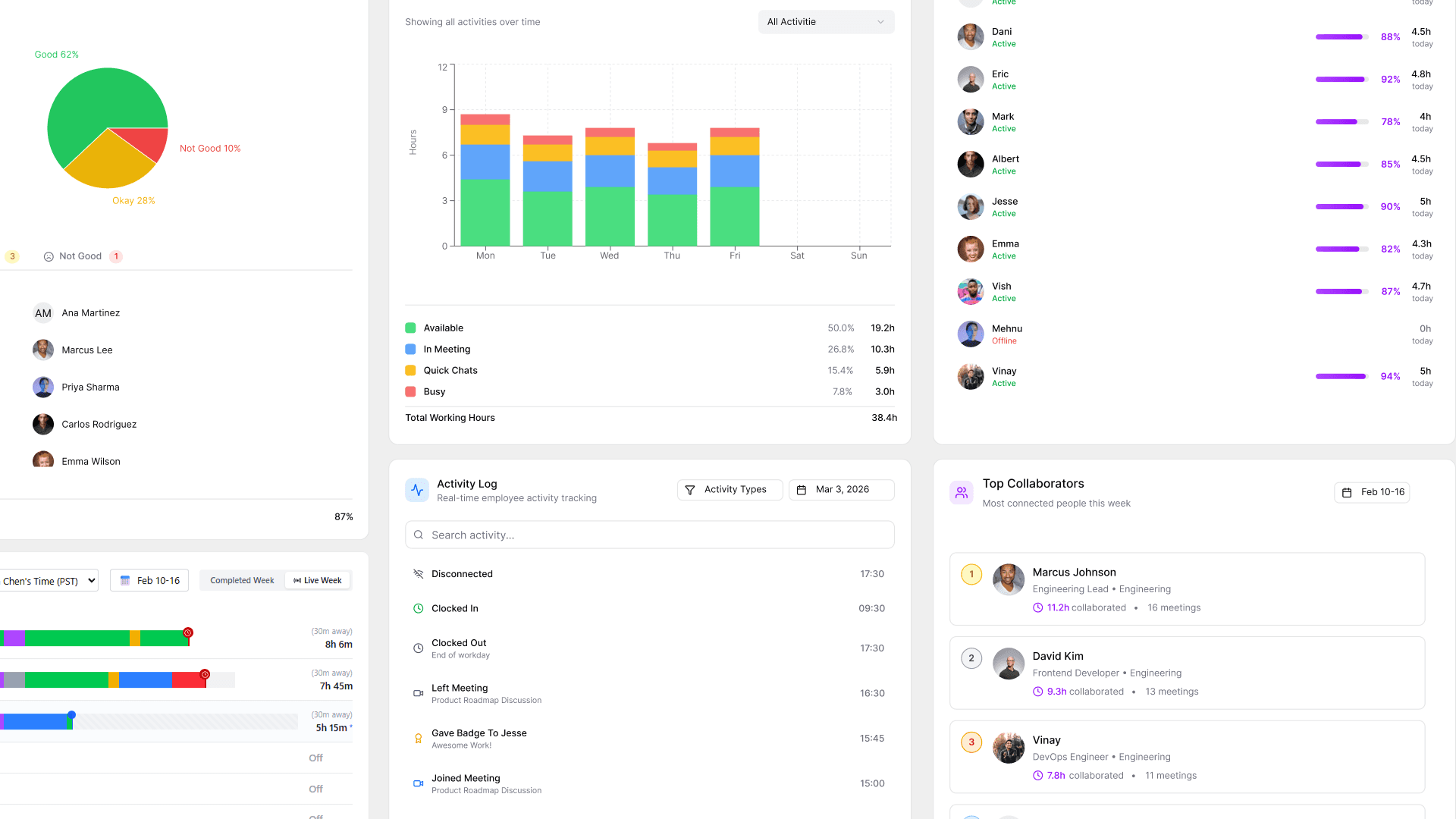
Análise de Equipes Remotas: O Guia Completo para Gestão do Trabalho Remoto Baseada em Dados em 2026
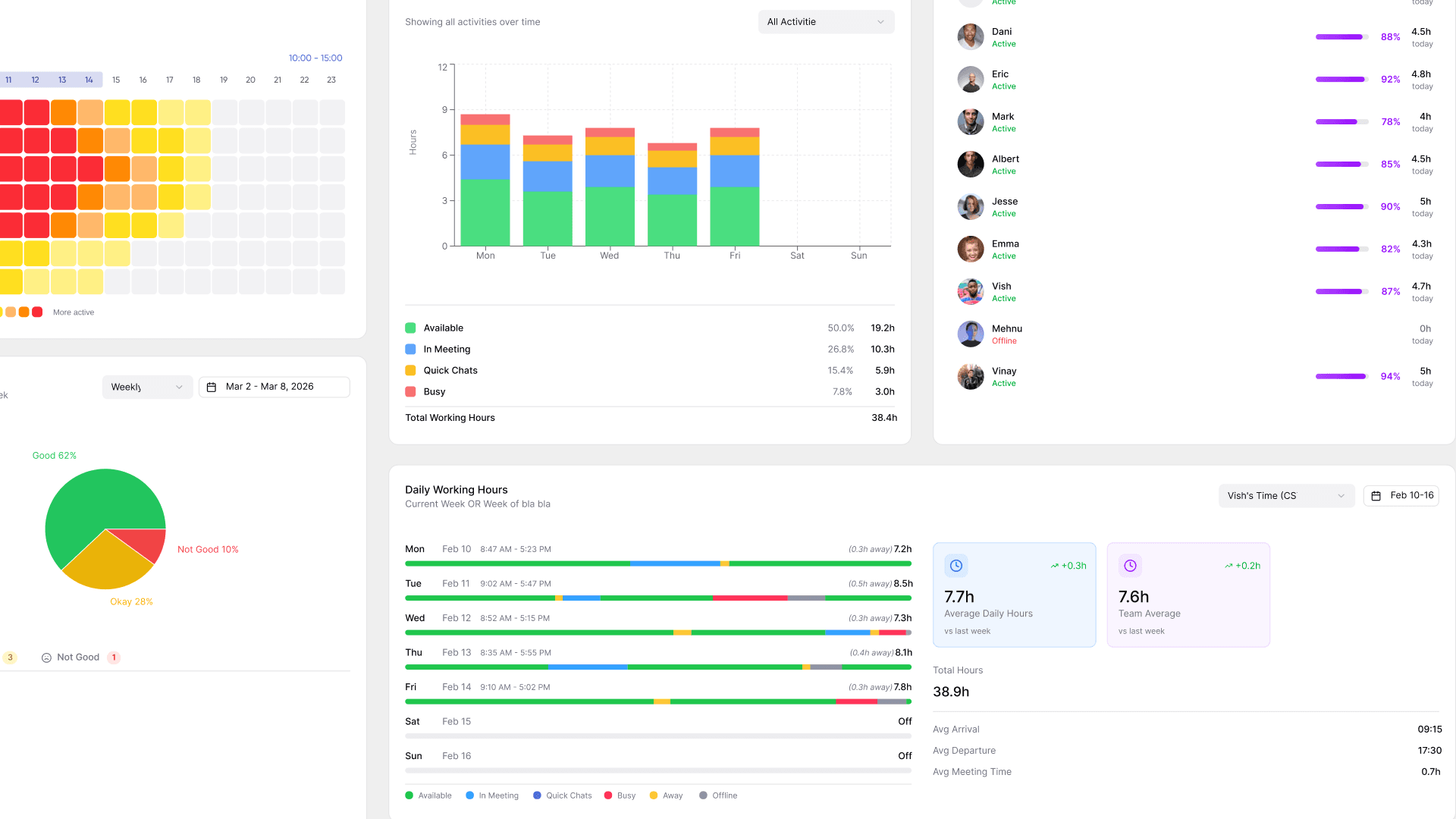
Guia Completo para Obter Visibilidade sobre o Desempenho e a Colaboração de Equipes Remotas