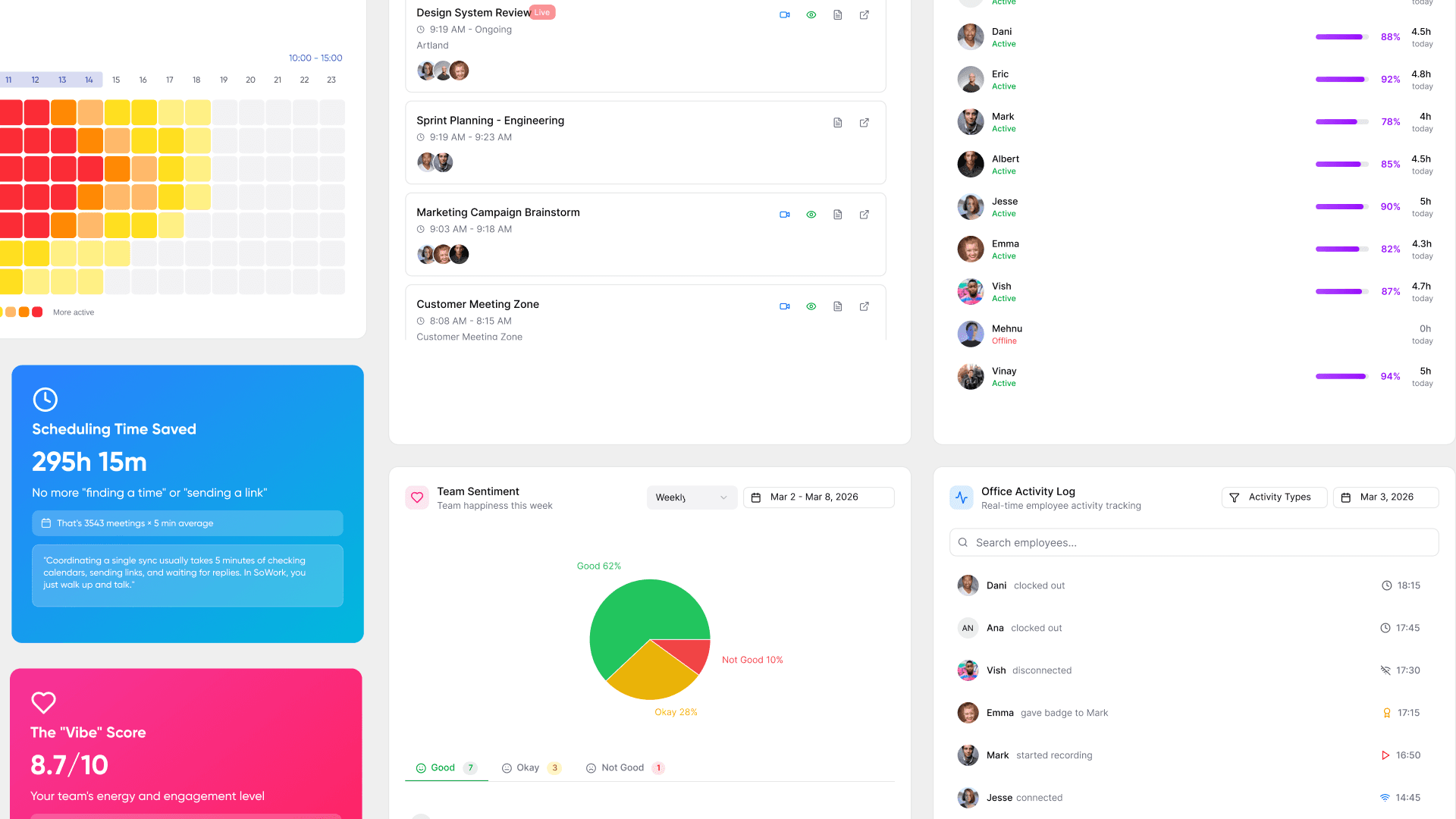
Cadência de Reuniões de Equipes Remotas: Com Que Frequência Vocês Devem se Reunir-se
Editorial SoWork

Publicado em:
Atualizado em:
A cadência ideal de reuniões para equipes remotas é de 3 a 5 reuniões estruturadas por semana por pessoa: uma reunião diária ou em dias alternados (standup), um alinhamento semanal da equipe, reuniões individuais quinzenais (one-on-ones), retrospectiva mensal e uma reunião geral trimestral (all-hands). Qualquer coisa além de duas horas de reuniões por dia prejudica consistentemente a produtividade, de acordo com a pesquisa do Workforce Index do Slack realizada com mais de 10.000 profissionais de escritório.
O que é cadência de reuniões e por que ela importa para equipes remotas?
A cadência de reuniões é o ritmo deliberado de reuniões recorrentes que uma equipe realiza, cobrindo quem se reúne, com que frequência e por quanto tempo. Para equipes remotas, é o principal substituto estrutural para a coordenação espontânea que acontece naturalmente em um escritório compartilhado.
Sem a proximidade física, as equipes remotas perdem as conversas de corredor e as rápidas interações ao lado da mesa. Reuniões agendadas preenchem essa lacuna, mas apenas se forem intencionais. Os funcionários remotos agora participam de 80% mais reuniões por semana do que os trabalhadores de escritório (25,6 contra 14,2 por semana) [1], embora 67% dessas reuniões sejam consideradas improdutivas [2]. Uma cadência bem planejada oferece às equipes pontos de contato suficientes para se manterem alinhadas sem consumir o tempo de foco que faz o trabalho remoto valer a pena.
Quais são os tipos essenciais de reuniões recorrentes que as equipes remotas precisam?
A maioria das equipes remotas precisa de cinco tipos de reuniões: standups diárias ou em dias alternados, alinhamentos semanais de equipe, reuniões individuais quinzenais com o gestor (1:1s), retrospectivas mensais e reuniões gerais trimestrais (all-hands). Cada uma serve a um propósito distinto e não devem ser unificadas.
Tipo de Reunião | Frequência Recomendada | Objetivo |
|---|---|---|
Standup / Sincronização | Diária ou 3x/semana | Bloqueios, prioridades |
Alinhamento de Equipe | Semanal | Alinhamento do projeto |
1:1 (Gestor) | Quinzenal | Crescimento, feedback |
Retrospectiva | Mensal | Melhoria de processos |
All-Hands (Geral) | Trimestral | Direcionamento da empresa |
Mantenha as standups abaixo de 15 minutos. Os alinhamentos de equipe devem ter uma pauta escrita compartilhada com antecedência; o GitLab exige isso para todas as reuniões [3]. O restante da semana pertence ao trabalho profundo (deep work).
Como a cadência de reuniões varia de acordo com o tamanho da equipe em organizações remotas?
Equipes remotas menores (menos de 15 pessoas) podem se reunir com mais frequência e com menos burocracia porque os custos de coordenação são menores. Equipes maiores precisam de uma disciplina de cadência mais rígida para evitar o excesso de reuniões que destrói o tempo de foco individual.
Tamanho da Equipe | Standup | Alinhamento de Equipe | All-Hands |
|---|---|---|---|
5 a 15 | Diária | Semanal | Mensal |
16 a 50 | 3x/semana | Semanal | Trimestral |
51 a 200 | Assíncrona ou 2x/semana | Quinzenal | Trimestral |
Em escala corporativa, 59% dos funcionários registram mais de 5 horas de reuniões por semana, em comparação com apenas 32% em empresas menores [4]. Equipes menores conseguem absorver standups diárias sem prejuízos. As maiores não conseguem; atualizações assíncronas devem substituir muitas delas.
Como a cadência de reuniões varia entre as diferentes áreas de uma equipe remota?
As equipes de Vendas e RH naturalmente realizam um volume maior de reuniões porque seu trabalho é focado em relacionamentos. Equipes de engenharia e design precisam de longos períodos de foco ininterrupto, por isso suas cadências devem ser mais leves e voltadas para o assíncrono.
Pesquisas sobre padrões de agendamento mostram que as áreas de recursos humanos e vendas têm maior dispersão de reuniões semanais, enquanto engenheiros, designers e cientistas concentram suas reuniões para proteger blocos de foco [5]. Um ponto de partida prático:
Engenharia: Standup assíncrona, alinhamento semanal de sprint, retrospectiva quinzenal
Vendas: Standup diária de pipeline, reunião semanal de previsão (forecast), revisão mensal da equipe
Design: Crítica quinzenal, alinhamento semanal com produto
Ops/RH: Alinhamento semanal de equipe, reunião interfuncional (cross-functional) quinzenal
Adapte a cadência ao trabalho, não a um modelo genérico.
Com que frequência as equipes remotas devem realizar reuniões gerais (All-Hands) ou de toda a empresa?
A reunião geral (all-hands) trimestral é a cadência mais comum e eficaz para empresas remotas. A frequência mensal funciona bem para equipes com menos de 30 pessoas. Reuniões semanais para toda a empresa quase sempre se tornam perda de tempo em qualquer escala significativa.
Empresas remotas de alto desempenho tratam o all-hands como um momento de alinhamento estratégico, não como uma atualização de status. O GitLab realiza reuniões de kickoff trimestrais e uma assembleia anual presencial separada [6]. O objetivo é reforçar a direção, celebrar vitórias e dar a cada funcionário uma visão clara das prioridades da empresa. Mantenha-as com menos de 60 minutos, grave-as para visualização assíncrona e envie um resumo escrito em seguida. Não gravar significa que 70% das decisões compartilhadas na reunião serão esquecidas em 24 horas [7].
Com que frequência as equipes remotas devem realizar reuniões de alinhamento ou standups no nível da equipe?
Três vezes por semana é o ponto ideal para a maioria das standups de equipes remotas. A frequência diária funciona para sprints rápidos; dia sim, dia não funciona para fluxos de trabalho mais estáveis. Standups cinco dias por semana frequentemente se tornam mecânicas e são as primeiras reuniões às quais as pessoas deixam de prestar atenção.
Uma standup deve responder a três perguntas: o que você entregou, no que está trabalhando e o que está te bloqueando. Mantenha em 15 minutos ou menos. Se a sua equipe abrange diferentes fusos horários, uma standup escrita assíncrona (postada em um canal compartilhado) pode substituir completamente a chamada ao vivo sem perder o alinhamento. O Workforce Index do Slack descobriu que profissionais que passam mais de duas horas por dia em reuniões têm mais de duas vezes mais chances de relatar falta de tempo de foco [8]. Proteger esse tempo de foco começa na standup.
Qual é a cadência ideal para reuniões individuais (One-on-Ones) em equipes remotas?
As reuniões individuais quinzenais são o padrão ideal para a maioria dos gestores remotos e seus subordinados diretos. Reuniões semanais funcionam bem durante a integração (onboarding) ou em casos de problemas de desempenho. A frequência mensal é muito espaçada para construir a confiança e os ciclos de feedback que o trabalho remoto exige.
As reuniões individuais (1:1s) são as de maior impacto que um gestor remoto realiza. É nelas que você identifica o esgotamento (burnout) precocemente, destrava o crescimento profissional e constrói o relacionamento que faz todo o resto funcionar. Mantenha em 30 minutos, use um documento compartilhado contínuo para os tópicos da pauta e resista à tentação de cancelá-las quando a rotina estiver corrida. Cancelar uma 1:1 envia um sinal claro ao funcionário de que ele não é uma prioridade. Para novos contratados, 1:1s semanais nos primeiros 90 dias melhoram drasticamente a retenção e o tempo de rampa.
Com que frequência as equipes remotas devem realizar retrospectivas e avaliações de saúde da equipe?
Retrospectivas mensais funcionam bem para a maioria das equipes remotas. Equipes de engenharia que realizam sprints de duas semanas devem fazer a retrospectiva ao final de cada sprint. Pesquisas trimestrais de saúde da equipe (separadas das retrospectivas) dão aos gestores uma visão mais ampla das tendências de moral e engajamento.
As retrospectivas são o espaço onde as equipes remotas melhoram seus processos, e não apenas suas entregas. Sem elas, os mesmos pontos de atrito se repetem indefinidamente. O Buffer usa pesquisas da Culture Amp para monitorar a saúde da equipe, incluindo felicidade pessoal e satisfação no trabalho, oferecendo à liderança uma visão holística de como as pessoas estão se sentindo [9]. Uma boa retrospectiva dura de 45 a 60 minutos e cobre três perguntas: o que funcionou, o que não funcionou e o que vamos mudar. Documente os planos de ação, caso contrário, a reunião vira apenas teatro.
Uma reunião deve ser recorrente ou assíncrona? Veja como decidir.
Uma reunião deve ser recorrente apenas se exigir discussão em tempo real, tomada de decisões ou construção de relacionamento que o formato assíncrono não possa replicar. Se o objetivo for compartilhar informações ou atualizações de status, o assíncrono quase sempre é a melhor opção.
Faça este teste antes de agendar qualquer reunião recorrente:
Exige debate ao vivo? Se não, use uma atualização escrita.
Uma decisão será tomada? Decisões precisam de reuniões. Atualizações de status não.
O resultado é urgente? O formato assíncrono funciona perfeitamente para alinhamentos não urgentes.
Promove a conexão da equipe? Algumas reuniões justificam sua existência apenas pela cultura.
Mais de 55% dos trabalhadores remotos dizem que a maioria das reuniões poderia ter sido um e-mail [10]. Isso não é cinismo, é um sinal de que as reuniões recorrentes vão se acumulando sem nunca serem reavaliadas.
Quais são os riscos de ter reuniões em excesso para equipes remotas?
O excesso de reuniões fragmenta o tempo de foco, gera esgotamento (burnout) e empurra o trabalho real para o período da noite. Trabalhadores remotos já participam de 80% mais reuniões por semana do que seus colegas de escritório, e 49% relatam fadiga significativa de chamadas de vídeo semanalmente.
Os funcionários remotos participam de 80% mais reuniões por semana do que os trabalhadores presenciais [1], e 49% dos profissionais remotos relatam cansaço significativo com chamadas de vídeo toda semana [11]. Os efeitos colaterais são reais: reuniões de vídeo seguidas aumentam os biomarcadores de estresse em até 20% em comparação com reuniões presenciais [11], e profissionais que ultrapassam duas horas diárias de reuniões têm mais que o dobro de chances de relatar falta de tempo para se concentrar [8]. Reuniões, e-mails e chats já consomem 57% do dia de trabalho médio [12], deixando menos da metade para a produção real.
Quais são os riscos de ter poucas reuniões em uma equipe remota?
A falta de reuniões cria silos, desgasta a confiança e deixa os trabalhadores remotos sentindo-se desconectados. Apenas 36% dos trabalhadores remotos relatam conseguir manter interações fortes com colegas ao trabalhar de forma remota.
Uma análise de 2022 com 60.000 funcionários da Microsoft descobriu que o trabalho totalmente remoto fez com que as redes profissionais se tornassem mais isoladas ao longo do tempo, com funcionários formando menos conexões fora de suas equipes diretas, e que o isolamento de rede se correlaciona com menor capacidade de inovação [13]. Mudar do escritório em tempo integral para o remoto em tempo integral aumenta a sensação de solidão em 67% [14]. Sem pontos de contato estruturados suficientes, as equipes remotas se dispersam. As pessoas deixam de sinalizar bloqueios, os gestores perdem visibilidade e a cultura se desgasta silenciosamente. A solução não é fazer mais reuniões, mas sim as reuniões certas com a frequência certa.
Como um escritório virtual pode substituir algumas reuniões recorrentes?
Uma plataforma de escritório virtual replica a percepção de presença de um escritório físico, permitindo que os colegas vejam quem está disponível e iniciem uma conversa instantaneamente, sem a necessidade de um convite no calendário. Isso resgata a interação espontânea que as equipes remotas perdem e elimina toda uma categoria de reuniões recorrentes desnecessárias.
O recurso de Percepção de Presença do SoWork mostra quem está livre, focado ou em reunião em tempo real, imitando os sinais visuais de um escritório compartilhado. Reuniões Instantâneas permitem iniciar uma conversa com um clique, sem agendamentos, sem compartilhamento de links e sem atritos. Esse é o equivalente remoto de dar um toque no ombro de alguém. Quando as equipes conseguem ver a disponibilidade umas das outras e se conectar espontaneamente, aquela reunião recorrente de "alinhamento rápido" muitas vezes se torna desnecessária. A Memória de Reunião por IA grava, transcreve e resume automaticamente qualquer conversa que aconteça, para que nada se perca.
Assíncrono primeiro vs. Reuniões síncronas: O que mantém as equipes remotas mais alinhadas?
Ferramentas focadas em assíncrono resolvem o compartilhamento de informações, atualizações de status e decisões não urgentes melhor do que reuniões síncronas. As reuniões síncronas ganham em decisões complexas, conversas delicadas e construção de relacionamento. As melhores equipes remotas utilizam ambos de forma deliberada.
A Automattic funciona quase inteiramente com comunicação assíncrona baseada em texto, reservando reuniões para situações que realmente exigem conversas ao vivo [9]. O GitLab impõe um critério rigoroso para qualquer reunião, exigindo uma pauta escrita compartilhada e resultados documentados que retornam para o manual (handbook) da empresa [3]. O ponto-chave: o assíncrono escala entre fusos horários e protege o tempo de foco, mas não consegue substituir totalmente a confiança e a velocidade de uma conversa ao vivo. Equipes que operam apenas no formato assíncrono costumam perceber que o alinhamento se deteriora silenciosamente ao longo das semanas. O ideal é: assíncrono por padrão, síncrono por exceção.
O que dizem as pesquisas sobre a quantidade ideal de reuniões por semana?
O Workforce Index do Slack, baseado em mais de 10.000 profissionais de escritório, revelou que duas horas de reuniões por dia é o limite a partir do qual a maioria dos trabalhadores se sente sobrecarregada. Atualmente, os trabalhadores remotos têm uma média de 25,6 reuniões por semana, muito acima do que as pesquisas recomendam para uma produtividade sustentável.
Os profissionais remotos realizam em média 25,6 reuniões por semana, 80% a mais do que os trabalhadores presenciais [1]. A pesquisa do Slack com mais de 10.000 profissionais constatou que duas horas diárias de reuniões é o ponto de virada no qual a maioria se sente sobrecarregada [8], e aqueles que ultrapassam esse limite têm mais de duas vezes mais chances de sofrer com a falta de tempo de foco [8]. Em média, os funcionários passam 392 horas por ano em reuniões, o equivalente a mais de 16 dias inteiros de trabalho [15]. Empresas remotas de alto desempenho, como a Buffer, definem como meta cerca de 2 a 3 horas semanais de reuniões no total para colaboradores individuais [9], uma fração do que a maioria dos profissionais remotos vivencia hoje.
Como as equipes remotas devem auditar e corrigir uma cadência de reuniões ineficiente?
Comece listando todas as reuniões recorrentes, o objetivo de cada uma e quem realmente precisa participar. Cancele qualquer reunião que não tenha gerado uma decisão ou ação documentada nos últimos 30 dias. Em seguida, reconstrua a agenda do zero, mantendo apenas as reuniões que passarem no teste do formato assíncrono.
Faça uma auditoria de reuniões em quatro etapas:
Liste todas as reuniões recorrentes com o organizador, participantes e objetivo definido.
Revise as últimas 4 semanas: cada uma delas gerou uma decisão ou ação clara?
Cancele ou converta qualquer reunião cujo propósito principal seja compartilhar status. Torne-a assíncrona.
Defina uma revisão a cada 90 dias para avaliar o que sobrou.
Apenas 43% dos participantes de reuniões remotas sentem que seus encontros geram resultados claros de forma consistente [16]. Isso significa que mais da metade do seu calendário recorrente provavelmente está pronto para ser cancelado ou convertido. Comece por aí.
Qual cadência de reuniões as empresas de alto desempenho focadas em remoto utilizam?
Tanto o GitLab quanto a Automattic adotam a comunicação assíncrona como padrão e tratam as reuniões como último recurso. O GitLab exige uma pauta escrita para cada reunião e documenta todas as decisões em seu manual. A Automattic opera quase inteiramente por texto, utilizando reuniões raramente.
O GitLab estabelece um critério rigoroso para reuniões síncronas, exigindo pauta compartilhada antes e resultados documentados depois [3]. A Automattic eliminou totalmente o e-mail interno e funciona por comunicação assíncrona via texto, usando chamadas de vídeo esporádicas apenas quando estritamente necessário [9]. A Buffer busca manter cerca de 2 a 3 horas de reuniões por semana para colaboradores individuais [9]. Todas as três empresas realizam encontros presenciais anuais, que a Automattic descreve como "a semana que faz as outras 51 funcionarem" [9]. O padrão é claro: assíncrono por padrão, documentado sempre, síncrono raramente.
Como a distribuição de fusos horários afeta a cadência de reuniões remotas?
Equipes distribuídas por mais de 4 fusos horários devem migrar a maioria das reuniões recorrentes para o formato assíncrono e reservar chamadas síncronas para uma janela estreita de sobreposição de horários. Forçar reuniões fora do horário comercial para manter uma cadência pensada para apenas um fuso horário é o caminho mais rápido para o esgotamento e o ressentimento da equipe.
Mais de 70% das empresas com trabalho remoto possuem funcionários em múltiplos fusos horários [14], e organizar reuniões urgentes entre essas distâncias é um ponto problemático recorrente [14]. Um modelo prático:
Mesmo fuso horário (diferença de até 3 horas): Standups e alinhamentos ao vivo funcionam bem.
Diferença de 4 a 8 horas: Encontre uma janela de sobreposição de 1 a 2 horas; proteja-a apenas para reuniões de alinhamento de alto valor.
Totalmente distribuídos (8+ horas de diferença): Adote o assíncrono como prioridade absoluta. Use atualizações de vídeo gravadas, standups escritas e resumos de reuniões por IA para quem não puder participar ao vivo.
Faça um rodízio nos horários das reuniões para que as mesmas pessoas não fiquem sempre com os horários muito cedo ou muito tarde.
Quais ferramentas e recursos ajudam as equipes remotas a gerenciar a cadência de reuniões?
As melhores ferramentas reduzem o atrito do agendamento, registram os resultados das reuniões de forma automática e oferecem às equipes uma percepção de presença da disponibilidade uns dos outros, de modo que nem toda interação exija um convite formal de reunião.
Procure por estes recursos ao avaliar suas ferramentas de colaboração remota:
Recurso | Por Que Importa |
|---|---|
Percepção de presença | Veja quem está disponível sem precisar agendar |
Reuniões instantâneas | Inicie uma conversa com apenas um clique |
Resumos de reuniões por IA | Registre decisões sem a necessidade de anotações manuais |
Sincronização de calendário | Mantenha a disponibilidade atualizada de forma automática |
Suporte a standups assíncronas | Substitua standups ao vivo em diferentes fusos horários |
Sinalização de modo de foco | Proteja o trabalho profundo (deep work) sem parecer indisponível |
O SoWork reúne todos esses recursos em uma única plataforma, incluindo a Memória de Reunião por IA, que grava e resume conversas automaticamente, e Modos de Foco, que permitem aos colegas sinalizar períodos de trabalho profundo sem precisar sumir completamente da equipe.
Resumo: Qual é a cadência de reuniões ideal para sua equipe remota?
A cadência ideal de reuniões para equipes remotas é enxuta, intencional e estruturada em torno de processos que priorizam o assíncrono. Busque manter menos de duas horas de reuniões por dia por pessoa, estruture sua semana com uma standup e um alinhamento de equipe, realize reuniões individuais (1:1s) quinzenais e faça uma retrospectiva mensal. Qualquer outra reunião recorrente deve justificar sua existência ou ser eliminada. As equipes que entregam resultados mais rapidamente não são as que fazem mais reuniões, mas sim aquelas que substituíram agendamentos desnecessários por uma verdadeira percepção de presença e colaboração espontânea.
Principais Conclusões
Trabalhadores remotos fazem em média 25,6 reuniões por semana, 80% a mais do que os presenciais, mas pesquisas recomendam um número muito menor para manter a produtividade a longo prazo.
Duas horas de reuniões por dia é o limite tolerável antes que a maioria dos trabalhadores se sinta sobrecarregada, segundo o Workforce Index do Slack com mais de 10.000 profissionais.
A cadência essencial para a maioria das equipes remotas: standup diária ou 3x/semana, alinhamento semanal, 1:1s quinzenais, retrospectiva mensal e reunião geral (all-hands) trimestral.
Empresas focadas em assíncrono, como GitLab e Automattic, tratam reuniões como último recurso, exigem pautas escritas, documentam todas as decisões e buscam uma meta de 2 a 3 horas de reuniões semanais para colaboradores individuais.
Equipes com mais de 4 fusos horários de diferença devem priorizar standups assíncronas e proteger uma janela curta de sobreposição para chamadas síncronas essenciais.
Como 67% das reuniões remotas são consideradas improdutivas, faça uma auditoria do seu calendário a cada 90 dias e cancele tudo o que não tenha gerado uma decisão documentada.
Plataformas de escritório virtual que oferecem percepção de presença e reuniões instantâneas podem eliminar categorias inteiras de reuniões de acompanhamento desnecessárias.
Sem anotações, 70% das decisões tomadas em reuniões são esquecidas em 24 horas; resumos de reuniões por IA tornaram-se indispensáveis para equipes distribuídas.
Fontes
Perguntas Frequentes
Qual é a cadência ideal de reuniões para equipes remotas?
Com que frequência as equipes remotas devem realizar reuniões diárias (standups)?
Com que frequência os gestores devem realizar reuniões individuais com funcionários remotos?
Como saber se a sua equipe remota tem reuniões demais?
Uma plataforma de escritório virtual pode reduzir a necessidade de reuniões agendadas?
Blogs
Leia artigos semelhantes
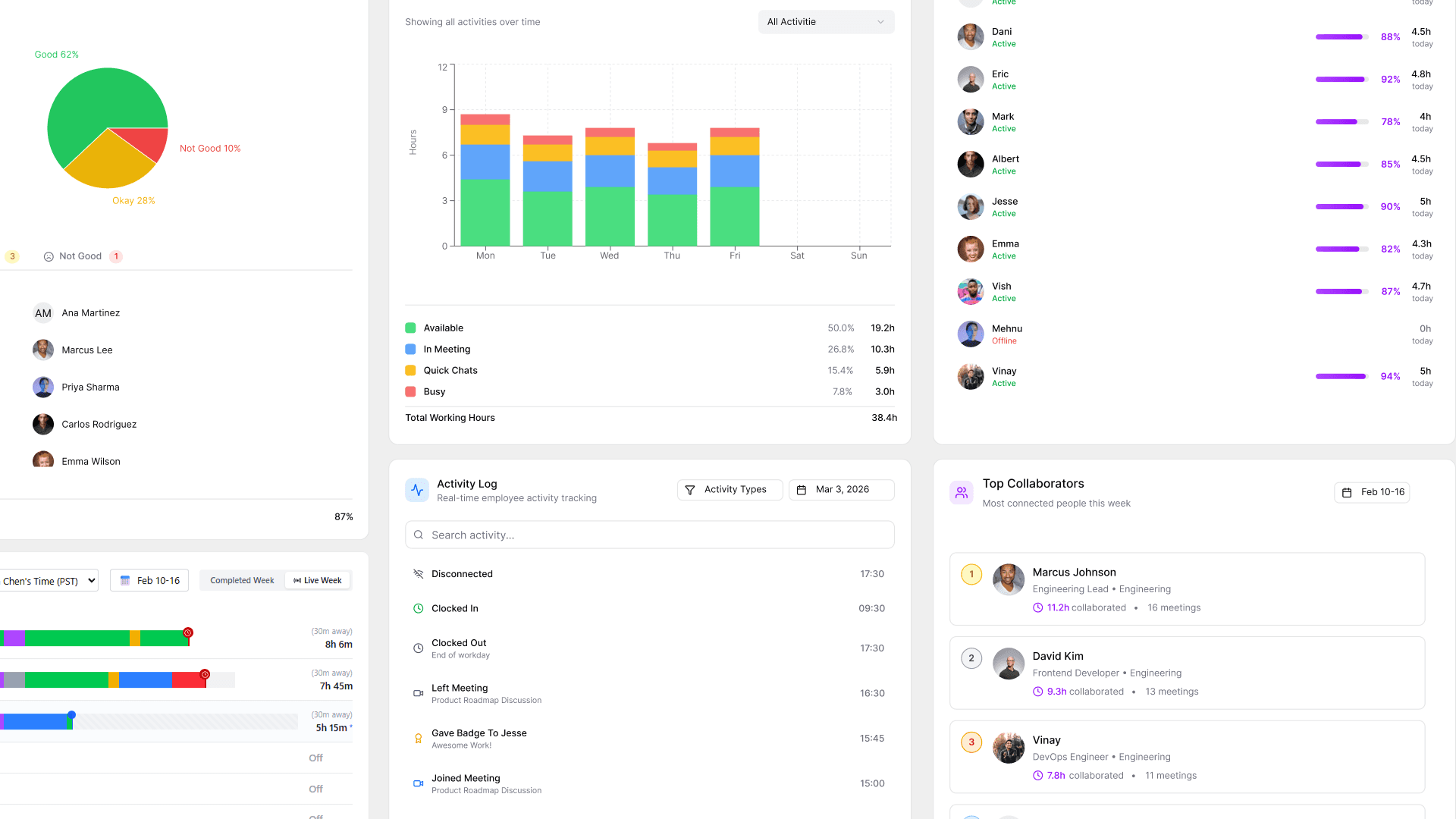
Análise de Equipes Remotas: O Guia Completo para Gestão do Trabalho Remoto Baseada em Dados em 2026
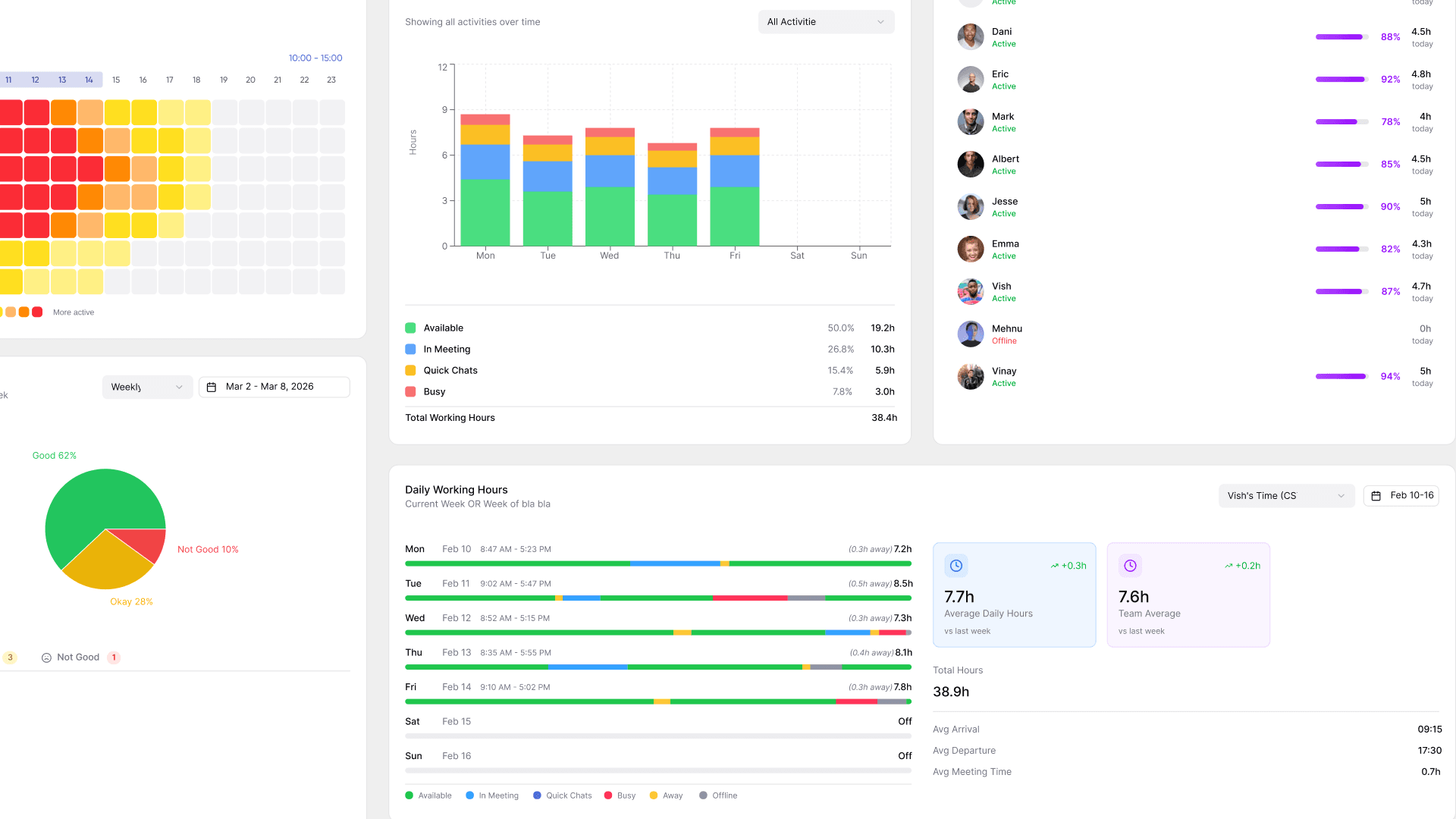
Guia Completo para Obter Visibilidade sobre o Desempenho e a Colaboração de Equipes Remotas