Como equipes remotas se alinham sem reuniões diárias
Editorial SoWork

Publicado em:
Atualizado em:
Equipes distribuídas mantêm o alinhamento sem reuniões diárias (standups) combinando percepção de presença ambiental, atualizações escritas assíncronas, ferramentas de acompanhamento de metas e conversas espontâneas por vídeo. Uma plataforma de escritório virtual que mostra a disponibilidade em tempo real substitui o ritual agendado por algo melhor: comunicação rica em contexto e sob demanda que não interrompe o trabalho focado nem exige concessões de fuso horário.
O que realmente significa alinhamento para equipes distribuídas?
Alinhamento de equipe significa que todos conhecem as prioridades, entendem quem está trabalhando em quê e podem expor impedimentos rapidamente. Remotamente, esse contexto compartilhado não acontece de forma passiva como ocorre em um escritório físico.
Em um escritório físico, o alinhamento é ambiental. Você ouve uma conversa por acaso, encontra alguém na máquina de café ou percebe a expressão de um colega em uma reunião. Nada disso existe por padrão em uma equipe distribuída. Você precisa construir o fluxo de informações deliberadamente. O principal desafio é que as equipes remotas costumam recorrer a ferramentas síncronas para tudo, transformando atualizações de status que poderiam ser uma mensagem escrita em um bloco de 30 minutos na agenda. Esse desgaste de coordenação se acumula diariamente, e as equipes acabam conversando sobre o trabalho mais do que realmente trabalhando.
Por que as reuniões diárias (standups) costumam falhar tanto em equipes distribuídas?
Reuniões planejadas para durar 15 minutos agora duram em média 30, e os desenvolvedores perdem 23 minutos de foco após cada uma delas. [1] Para equipes distribuídas que abrangem vários fusos horários, o custo operacional é ainda maior.
Alinhar uma reunião entre diferentes fusos horários força alguns membros da equipe a trabalhar fora do seu horário comercial. Mesmo quando o horário funciona, isso fragmenta os períodos de pico de foco. Uma pesquisa da Polly mostra que 90% dos participantes realizam outras tarefas simultaneamente durante reuniões, e 75% realizam outras tarefas de trabalho durante chamadas virtuais. [2] As reuniões diárias também saem do foco. As três perguntas rápidas se transformam em mini-retrospectivas e debates sobre arquitetura. [3] Uma equipe de 10 pessoas que perde apenas uma reunião extra de 30 minutos por semana devido ao prolongamento da reunião diária duplica o custo de tempo do ritual sem melhorar os resultados. [3]
Quais são as melhores alternativas às reuniões diárias para equipes distribuídas?
As alternativas mais robustas combinam atualizações assíncronas por escrito, ferramentas de acompanhamento de metas e um escritório virtual que oferece percepção de presença ambiental sem a necessidade de agendar nada.
Alternativa | O que ela substitui | Melhor para |
|---|---|---|
Atualizações assíncronas por escrito | Reunião de atualização de status | Todos os fusos horários |
Percepção de presença ambiental | Mensagens de "tem alguém livre?" | Resolução espontânea de problemas |
Ferramentas de visibilidade de metas e tarefas | Reuniões de relatório de progresso | Gerentes e líderes |
Escritório virtual (ex.: SoWork) | Chamadas de vídeo agendadas | Conversas informais de corredor |
Resumos de reuniões por IA | Reuniões de atualização de contexto | Qualquer pessoa que perdeu o contexto |
Equipes focadas em comunicação assíncrona que implementam esses sistemas reduzem as reuniões em 40% a 60% e entregam projetos mais rapidamente, de acordo com análises de empresas como GitLab e Zapier. [4]
Como a percepção de presença ambiental substitui as reuniões agendadas?
Quando você consegue ver rapidamente quem está livre, focado ou em reunião, não precisa de um ponto de contato agendado para saber se pode interromper alguém ou pedir uma revisão rápida.
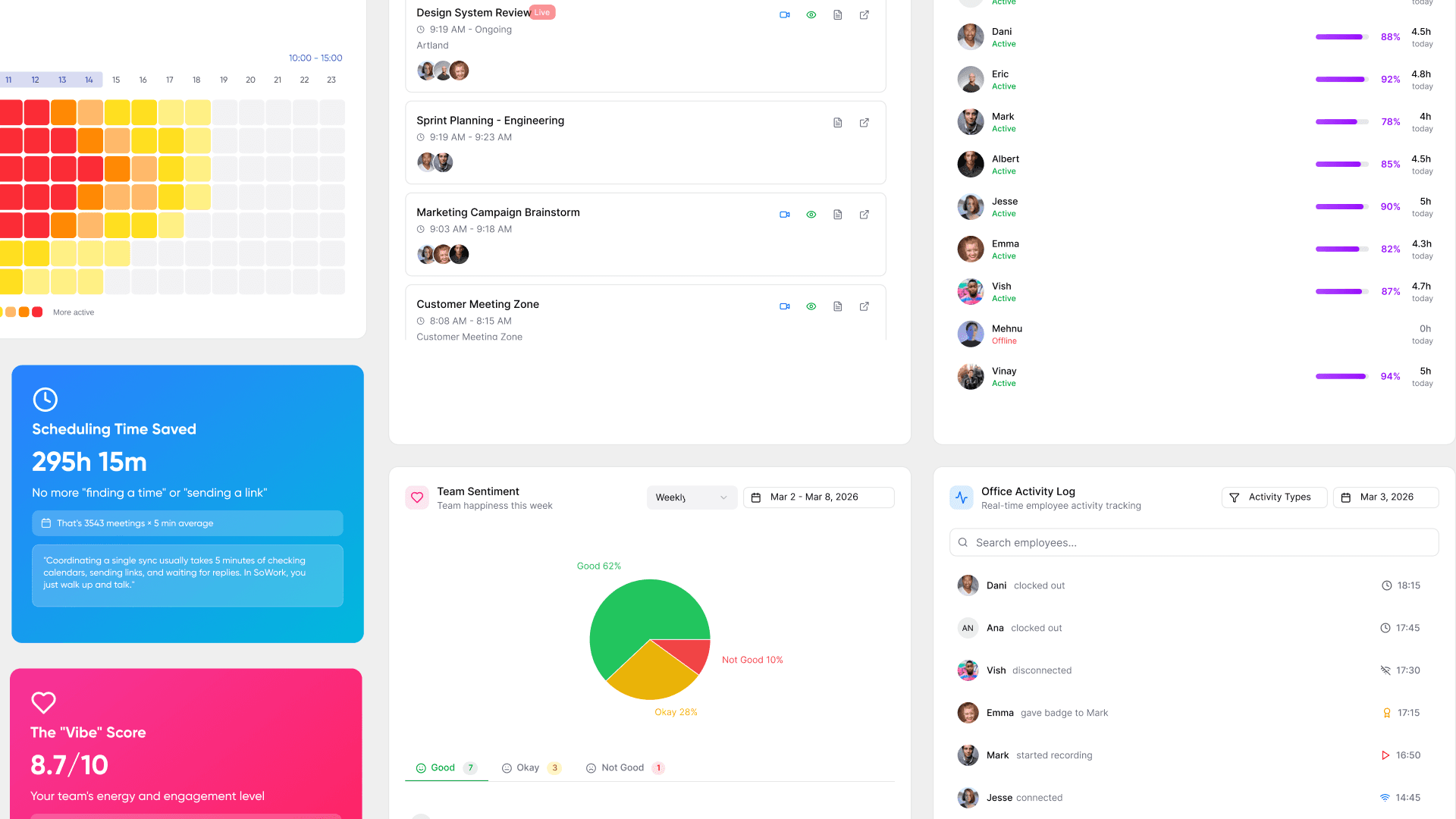
A percepção de presença replica a visão periférica de um escritório compartilhado. No SoWork, os indicadores visuais são atualizados automaticamente quando um evento do calendário começa, garantindo que a disponibilidade esteja correta sem que ninguém precise atualizar o status manualmente. Membros da equipe no Modo Foco sinalizam períodos de trabalho profundo, o que reduz interrupções desnecessárias. O resultado é que perguntas rápidas são respondidas em tempo real quando alguém está livre, evitando que se acumulem até a próxima reunião diária. Essa única mudança elimina o motivo mais comum pelo qual as equipes agendam reuniões diárias.
Como as atualizações de status assíncronas mantêm as equipes alinhadas sem reuniões?
Atualizações por escrito criam um registro pesquisável e com marcação de data/hora do progresso e dos impedimentos que todos podem ler em seu próprio horário. Isso é algo que uma reunião diária nunca poderá fazer.
A comunicação assíncrona funciona melhor para atualizações de status, registros de progresso e perguntas não urgentes com um responsável claro. [5] Equipes que mudam para atualizações de status assíncronas economizam até seis horas por semana em reuniões desnecessárias. [6] O segredo está na estrutura: uma publicação diária curta por escrito respondendo o que você entregou, qual é o próximo passo e o que está te bloqueando oferece aos gerentes e colegas as mesmas informações de uma reunião diária, sem o atrito na agenda. O chat baseado em tópicos do SoWork mantém essas atualizações contextualizadas e fáceis de escanear, evitando que as informações se percam em um canal geral.
Como as conversas espontâneas em um espaço de trabalho virtual substituem os papos de corredor?
As conversas de corredor são a comunicação de maior valor e menor atrito em qualquer escritório. Um espaço de trabalho virtual que permite iniciar uma chamada de vídeo com um clique chega muito perto disso.
A maioria das ferramentas remotas dificulta as conversas espontâneas em vez de facilitar. Agendar um link do Zoom para uma pergunta de dois minutos gera um atrito que mata o impulso de conversar. As Reuniões Instantâneas do SoWork permitem que você veja quem está disponível e inicie uma conversa sem a necessidade de um link, convite de calendário ou pauta pré-definida. Isso é o equivalente digital de caminhar até a mesa de alguém. Equipes que preservam esse tipo de interação de baixo impacto mantêm o fluxo informal de informações que deixa todos alinhados entre os alinhamentos formais.
Qual é o papel do escritório virtual na redução do isolamento e na manutenção da presença?
Profissionais totalmente remotos relatam um nível de solidão 25% maior do que os trabalhadores presenciais, de acordo com o relatório State of the Global Workplace de 2024 da Gallup. [7] Um escritório virtual aborda diretamente a falta de presença que impulsiona esse isolamento.
O isolamento não é apenas um problema de bem-estar. É um problema de produtividade. Funcionários engajados têm 64% menos probabilidade de sentir solidão do que os desengajados, e a solidão está correlacionada a um menor desempenho e a uma maior rotatividade de pessoal. [7] Um escritório virtual como o SoWork oferece às equipes um espaço compartilhado para coexistirem, e não apenas uma ferramenta para agendar chamadas. Escritórios e avatares personalizáveis criam uma sensação de lugar. Ver os colegas presentes em um ambiente compartilhado ao longo do dia reduz a sensação de "trabalhar no vácuo" que desgasta tanto o moral quanto o alinhamento.
Como as ferramentas de acompanhamento de metas reduzem a necessidade de reuniões de status?
Quando o status das tarefas está visível para todos em uma ferramenta compartilhada, a pergunta "em que pé estamos com isso?" é respondida sem a necessidade de perguntar a ninguém.
As atualizações de status são a maior fonte individual de reuniões desnecessárias, citadas por 53% dos profissionais como a principal categoria de desperdício de tempo em reuniões. [8] Ferramentas de gerenciamento de projetos que exibem o progresso das tarefas em tempo real fazem com que os gerentes não precisem de reuniões para fazer acompanhamentos. Eles podem simplesmente visualizar. Combine isso com o AI Meeting Memory do SoWork, que grava e resume automaticamente as conversas que ocorrem, e você terá eliminado completamente a lacuna de informação. Nada se perde e ninguém precisa de uma chamada de alinhamento para descobrir o que foi decidido.
Como uma equipe deve decidir se deve substituir, reduzir ou manter sua reunião diária?
Mantenha a reunião diária apenas se ela estiver gerando decisões de forma consistente ou resolvendo impedimentos no trabalho. Se for apenas para relatar status, substitua-a por comunicação assíncrona.
Faça três perguntas: A reunião gera consistentemente uma decisão ou ação que não poderia acontecer de forma assíncrona? Todos os participantes contribuem com algo de que os outros precisam? Todos estão em fusos horários compatíveis? Se a resposta para qualquer uma dessas perguntas for não, a reunião diária é candidata a substituição. A própria orientação da Atlassian é direta: para reuniões de status, o formato síncrono nunca é a escolha certa. [9] Um teste útil é fazer um experimento assíncrono de duas semanas e medir se os impedimentos são resolvidos de forma mais rápida ou mais lenta. A maioria das equipes se surpreende com o resultado.
Como um escritório virtual se compara a ferramentas puramente assíncronas para o alinhamento da equipe?
Ferramentas assíncronas como chat e mensagens de vídeo lidam bem com o compartilhamento de informações. No entanto, elas não oferecem conexão espontânea, percepção de presença ou a sensação ambiental de trabalhar ao lado de outras pessoas. Um escritório virtual faz as duas coisas.
Recurso | Ferramenta apenas de chat | Ferramenta de mensagem de vídeo | Escritório virtual (SoWork) |
|---|---|---|---|
Atualizações assíncronas de status | Sim | Sim | Sim |
Presença em tempo real | Não | Não | Sim |
Chamadas de vídeo espontâneas | Não | Não | Sim |
Resumos de reuniões por IA | Não | Não | Sim |
Reduz o isolamento | Baixo | Baixo | Alto |
Substitui a reunião diária totalmente | Parcial | Parcial | Sim |
O SoWork consolida reuniões, presença, chat e ferramentas de IA em um só lugar, reduzindo a alternância de contexto que fragmenta as equipes distribuídas entre vários aplicativos.
Como o SoWork se compara a outras plataformas de escritório virtual?
O SoWork foi desenvolvido especificamente para reduzir o excesso de reuniões em equipes de trabalho, não apenas para replicar a estética de um escritório. O AI Meeting Memory, a sincronização automática do calendário e os Modos Foco são recursos voltados para a produtividade, não apenas para a presença.
Muitas ferramentas de escritório virtual focam na metáfora visual de um escritório sem resolver o problema subjacente de alinhamento. O SoWork adiciona resumos de reuniões gerados por IA para que as conversas sejam documentadas automaticamente, sincronização automática de calendário para que a disponibilidade esteja sempre correta e Modos Foco para proteger o tempo de trabalho profundo por padrão. A integração leva poucos minutos e não requer download de software, o que é importante para equipes que já perderam a paciência com ferramentas que as pessoas acabaram não adotando. O objetivo é oferecer uma plataforma que as equipes realmente abram todas as manhãs, e não uma que visitem apenas para chamadas agendadas.
Quais são os riscos de cortar as reuniões diárias sem um sistema substituto?
Eliminar as reuniões diárias sem substituir o fluxo de informações que elas forneciam cria impedimentos invisíveis, desalinhamento de prioridades e um problema de visibilidade para os gerentes que só aparece quando já é tarde demais.
O verdadeiro trabalho de uma reunião diária é o fluxo de informações, não a reunião em si. Remova a reunião sem substituir o fluxo, e os impedimentos ficarão sem resolução. As prioridades se perdem. Os gerentes perdem a visibilidade de quem está travado. Pesquisas mostram que 33% dos profissionais remotos já passam mais tempo relatando o progresso do que passavam no escritório presencial. [10] Sem um sistema intencional, esse número piora ou desmorona de vez. A solução não é manter a reunião diária. É substituir o que ela realmente fazia: expor impedimentos rapidamente, confirmar prioridades e dar aos gerentes uma percepção do ritmo da equipe.
Como as equipes remotas de alto desempenho estruturam a semana com menos reuniões?
As melhores equipes distribuídas protegem o período de trabalho profundo pelas manhãs, usam atualizações assíncronas diariamente e reservam reuniões síncronas para decisões que realmente exigem discussões em tempo real.
Uma estrutura semanal prática: atualizações escritas assíncronas diárias levam 5 minutos e substituem a reunião diária. Um alinhamento semanal da equipe resolve decisões e planejamentos que não podem ser assíncronos. Chamadas espontâneas acontecem sob demanda por meio de um escritório virtual quando alguém está visivelmente disponível. Cerca de metade de todas as reuniões ocorrem atualmente entre as 9h e as 11h, período em que a maioria das pessoas realiza seu trabalho com melhor foco. [11] Proteger essa janela para o trabalho focado e transferir a coordenação para o formato assíncrono é a mudança de maior impacto que a maioria das equipes pode fazer.
O que as pesquisas dizem sobre reuniões diárias vs. comunicação assíncrona para o alinhamento de equipes remotas?
Estudos recentes mostram que a comunicação assíncrona reduz a fadiga de reuniões em 42% para equipes remotas. [12] Enquanto isso, 72% das reuniões são classificadas como ineficazes, e as reuniões diárias planejadas para 15 minutos agora duram em média 30. [1]
Um estudo revisado por pares de 2025 no European Journal of Work and Organizational Psychology descobriu que as reuniões diárias virtuais enfrentam desafios únicos decorrentes de fusos horários, diferenças nos estilos de comunicação e o cansaço gerado pela alta frequência de interações virtuais. [13] A própria pesquisa da Atlassian descobriu que funcionários remotos agora participam de 50% mais reuniões do que seus colegas presenciais, e 77% já participaram de reuniões que serviram apenas para agendar outra reunião. [14] As evidências apontam para a mesma direção: a comunicação assíncrona funciona muito bem para atualizações de status. Reuniões síncronas devem ser reservadas para problemas ambíguos que exigem alinhamento rápido.
Como manter a cultura e a coesão ao eliminar a reunião diária?
Cultura não surge de um evento recorrente na agenda. Ela vem do sentimento de ser visto, valorizado e conectado aos colegas de equipe. O ritual da reunião diária pode ser substituído por pontos de contato melhor planejados.
A pesquisa de 2024 da Gallup descobriu que funcionários engajados têm 64% menos probabilidade de sentir solidão, e que o engajamento importa muito mais do que qualquer formato de reunião específico. [7] O segredo é substituir a função social do ritual de forma deliberada: um escritório virtual onde as pessoas estão visivelmente presentes, um alinhamento semanal com tempo reservado para conversas informais e chamadas espontâneas que acontecem naturalmente quando alguém está disponível. O sistema de escritório e avatares personalizáveis do SoWork oferece às equipes uma identidade e um espaço compartilhados, o que pesquisas sugerem que importa mais para o sentimento de pertencimento do que a frequência de reuniões agendadas.
Quanto custa realmente o excesso de reuniões para equipes distribuídas?
Estima-se que os profissionais percam 146 horas por ano em reuniões que não agregam valor, custando cerca de US$ 6.280 por pessoa em salários desperdiçados. [15] Mas a falta de comunicação também tem seu custo: impedimentos invisíveis e desgaste da confiança.
O excesso de reuniões é mensurável. Funcionários remotos participam de 50% mais reuniões do que os colegas de escritório, passando 11,3 horas por semana — ou 28% de sua jornada de trabalho — em reuniões. [16] Em dias com muitas reuniões, 76% dos profissionais relatam cansaço, mesmo quando o total de horas de trabalho permanece o mesmo. [17] A falta de comunicação é mais difícil de medir, mas igualmente prejudicial: os impedimentos se acumulam, as prioridades se perdem e os membros da equipe se sentem isolados. O objetivo não é reduzir reuniões a qualquer custo, mas sim ter uma comunicação na medida certa, onde a comunicação assíncrona cuida do fluxo de informações e as reuniões síncronas cuidam do alinhamento real.
Como os gerentes mantêm a visibilidade sem reuniões diárias?
Gerentes que dependem de reuniões diárias para ter visibilidade ficam sem rumo a cada cancelamento de reunião. A melhor abordagem é incorporar a visibilidade ao próprio fluxo de trabalho.
Três ferramentas dão aos gerentes o que eles precisam sem uma reunião diária: um painel de tarefas compartilhado onde o status do trabalho está sempre visível, atualizações assíncronas escritas diárias que expõem os impedimentos por escrito e um escritório virtual com percepção de presença para que os gerentes vejam quem está focado versus quem está disponível para uma conversa rápida. O AI Meeting Memory do SoWork significa que qualquer conversa ocorrida é resumida automaticamente e se torna pesquisável. Os gerentes deixam de perguntar "o que foi decidido?" e passam a dedicar sua atenção à resolução real dos impedimentos.
Quais passos uma equipe deve dar para fazer a transição e abandonar as reuniões diárias?
Não cancele apenas a reunião diária. Substitua cada função que ela desempenhava antes de remover o compromisso da agenda.
Faça uma auditoria do que sua reunião diária realmente faz: compartilhamento de status, exposição de impedimentos, conexão social ou os três.
Substitua o compartilhamento de status por uma atualização escrita assíncrona diária em um canal estruturado.
Configure um escritório virtual para que a presença fique visível e chamadas espontâneas possam acontecer sem agendamento.
Transfira o encaminhamento de impedimentos para um canal dedicado com uma norma clara de tempo de resposta.
Mantenha um encontro síncrono semanal para decisões que realmente necessitem de alinhamento em tempo real.
Rode o novo sistema por duas semanas antes de remover a reunião diária por completo.
Use resumos de reuniões por IA para todas as chamadas que acontecerem, garantindo que nada se perca.
Equipes que seguem essa sequência substituem a função da reunião diária sem perder os seus benefícios.
Conclusão: O que as equipes distribuídas devem realmente fazer?
A reunião diária não é o problema. Tratá-la como o único mecanismo de alinhamento é que é. Equipes distribuídas que se mantêm alinhadas sem reuniões diárias incorporam o fluxo de informações em suas ferramentas e ambientes, e não em suas agendas. Um escritório virtual com percepção de presença, atualizações assíncronas e resumos de reuniões por IA oferece tudo o que uma reunião diária deveria fornecer, sem o custo de tempo operacional.
Se você é fundador ou líder de uma equipe distribuída, o caminho é simples: audite o que sua reunião diária realmente faz, substitua cada função deliberadamente e dê à sua equipe um ambiente compartilhado onde a presença e a comunicação aconteçam naturalmente. O SoWork foi construído exatamente para isso. Sua equipe ganha a conexão ambiental de um escritório compartilhado sem o deslocamento físico, e você garante o alinhamento sem o custo do excesso de reuniões.
Principais Conclusões
As reuniões diárias planejadas para 15 minutos duram agora em média 30, e os desenvolvedores perdem 23 minutos de foco após cada uma delas — o custo operacional é real e mensurável.
Os funcionários remotos já participam de 50% mais reuniões do que os colegas de escritório, passando 28% de sua semana de trabalho em reuniões.
A comunicação assíncrona reduz o cansaço de reuniões em 42% para equipes remotas e funciona melhor para atualizações de status, registros de progresso e perguntas não urgentes.
Funcionários totalmente remotos relatam um nível de solidão 25% maior do que os presenciais; um escritório virtual com presença ambiental aborda diretamente essa lacuna.
Nunca cancele apenas a reunião diária. Substitua cada função que ela desempenhava: compartilhamento de status, exposição de impedimentos e conexão social.
Um escritório virtual como o SoWork combina percepção de presença, reuniões instantâneas e resumos de reuniões por IA em uma única plataforma, substituindo a reunião diária sem perder os seus benefícios.
Gerentes que dependem de reuniões diárias para ter visibilidade devem migrar para painéis de tarefas compartilhados, atualizações assíncronas e ferramentas de percepção de presença, para que a visibilidade seja incorporada ao próprio trabalho.
O objetivo não é reduzir reuniões a qualquer custo, mas sim ter uma comunicação na medida certa, onde o formato assíncrono cuida do fluxo de informações e as reuniões síncronas tratam do alinhamento real.
Fontes
Perguntas Frequentes
Como as equipes distribuídas mantêm o alinhamento sem reuniões diárias de standup?
Quais são as melhores alternativas às reuniões diárias (daily standups) para equipes remotas?
Quais são os riscos de eliminar as reuniões diárias (daily standups) sem uma substituição?
Como um escritório virtual reduz a necessidade de reuniões de acompanhamento agendadas?
Como os gestores mantêm a visibilidade do progresso da equipe sem reuniões diárias de alinhamento?
Blogs
Leia artigos semelhantes
Análise de Equipes Remotas: O Guia Completo para Gestão do Trabalho Remoto Baseada em Dados em 2026
Guia Completo para Obter Visibilidade sobre o Desempenho e a Colaboração de Equipes Remotas